Introduction: The Unique Challenge of the “Dubai Child”
Raising a child in Dubai is a privilege. Our children grow up surrounded by futuristic innovation, safety, and a kaleidoscope of cultures. However, this unique environment brings unique challenges. Many of our children are “Third Culture Kids” (TCKs)—growing up in a country that is not their parents’ home. They face a transient community where friends move away, a lifestyle that often relies heavily on domestic help, and a competitive academic race that starts earlier than ever.
In this whirlwind of luxury and transition, how do you give your child roots?
The answer lies in an education that offers consistency, functional independence, and emotional grounding. Here is why an authentic Montessori education is not just a school choice, but a lifestyle anchor for families in the UAE.
1. Countering “Maid Culture”: The Gift of Functional Independence
One of the most common topics in Dubai parenting circles is the reliance on domestic help. While nannies are a blessing for working parents, excessive assistance can unintentionally rob a toddler of their “I can do it myself” moments.
- The “Help” Trap: If a nanny feeds, dresses, and cleans up after a 3-year-old, the child may develop “learned helplessness,” lacking the fine motor skills and confidence to manage basic tasks.
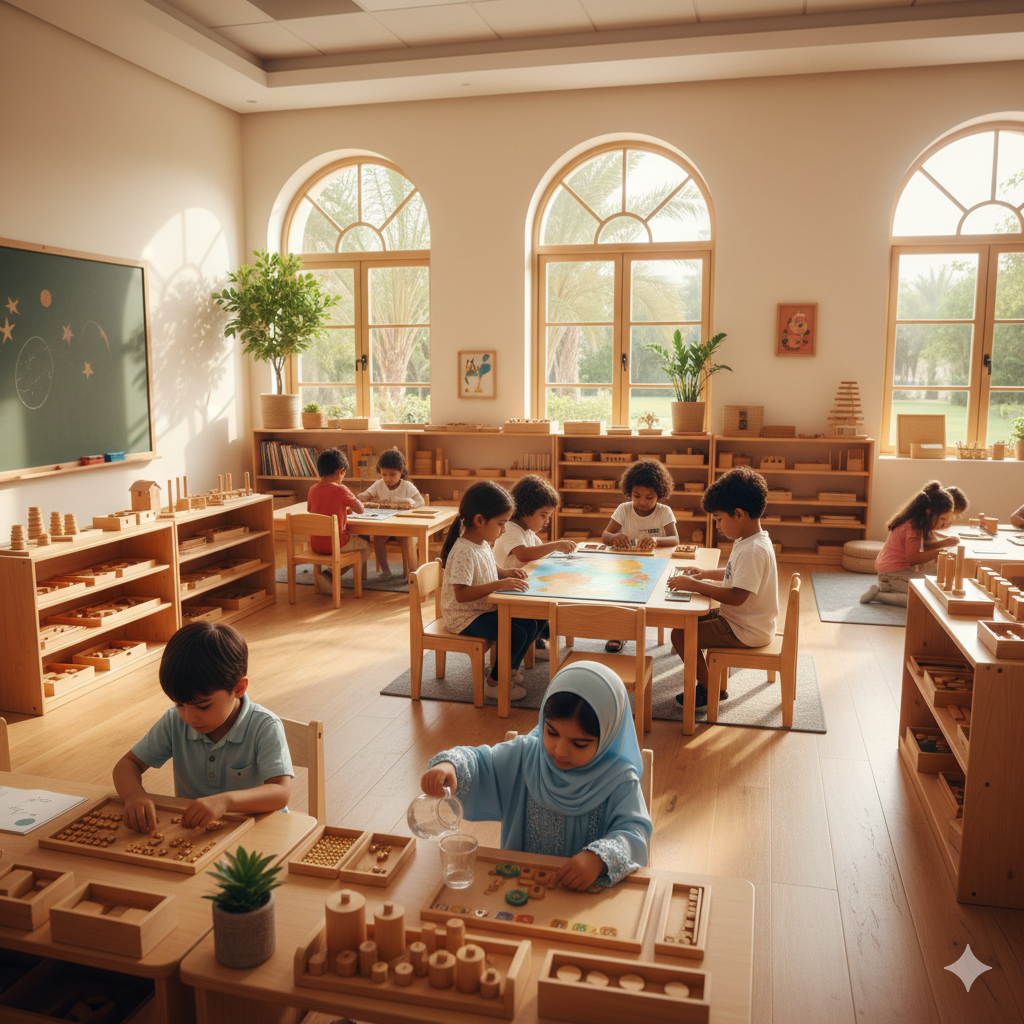
- The Montessori Antidote: In our classrooms, independence is the curriculum.
- Self-Care: Children learn to fasten their own velcro shoes, button their shirts, and wash their hands independently at child-height sinks.
- Food Preparation: Instead of being served, toddlers slice their own bananas, pour water from small glass pitchers, and clean their own spills.
- The Outcome: This builds self-efficacy. A child who can care for themselves does not need to be entertained; they are empowered. This transition from “being served” to “doing” is often the most profound change parents witness after enrollment.
2. The Bilingual Advantage: Arabic as a Living Language
For many expat families, learning Arabic is a desire but feels like a hurdle. Traditional methods often treat Arabic as a dry subject restricted to a 30-minute lesson.
- The Absorbent Mind: Dr. Montessori proved that children under six do not “learn” language; they absorb it like a sponge absorbs water.
- Immersion, Not Instruction: In a high-quality Dubai Montessori setting, Arabic is woven into the fabric of the day.
- Contextual Learning: A child doesn’t just see a flashcard of an apple; they hold a real apple while an educator names it in Arabic. They hear Arabic songs during transitions and simple commands during play.
- Cultural Connection: This soft immersion removes the fear of a new language, making Arabic a natural, friendly part of their world rather than a difficult subject to be tackled later in big school.
3. Stability for the “Third Culture Kid” (TCK)
TCKs are adept at adapting, but they often struggle with a sense of belonging. When their external world changes (friends leaving, summer travel), their internal world needs structure.
- The Universal Classroom: A Montessori classroom in Dubai looks remarkably similar to one in London, Tokyo, or New York. The materials (Pink Tower, Cylinder Blocks) are universal.
- Emotional Anchoring: This familiarity provides deep psychological safety. No matter how much their life outside changes, the classroom remains a predictable, orderly haven where they know exactly where everything belongs. This external order creates internal calm, reducing anxiety in transient lifestyles.
4. Beating the “Summer Slump”: Bringing Nature Indoors
The UAE summer is long, and “Nature Deficit Disorder” is a real risk when outdoor play is restricted for months.
- Biology in the Classroom: We don’t just read about nature; we bring it inside.
- Botany: Children use “Botany Cabinets” to trace leaf shapes and learn scientific names. They care for indoor plants, learning that living things rely on them for survival.
- Zoology: From observing an ant farm to studying the lifecycle of a butterfly, the curriculum keeps the connection to the natural world alive, fostering stewardship even when it’s 45°C outside.
5. Preparing for the Giants: Transitioning to IB, British, or American Schools
Dubai is home to some of the world’s most competitive private schools. Parents often worry: “Will Montessori prepare my child for the rigors of a Grade 1 assessment in a big British or IB school?”
The answer is yes—often better than traditional nurseries.
- Executive Function: Top schools today value “soft skills” over rote knowledge. They look for children who can follow multi-step instructions, focus on a task without distraction, and regulate their emotions. These are the core outcomes of the Montessori work cycle.
- Academic Head Start:
- Math: While others are memorizing songs about numbers, Montessori children are physically handling 4-digit numbers using the Golden Beads. They understand quantity, not just counting.
- Literacy: Through phonics and sandpaper letters, many Montessori children begin reading and writing spontaneously before age six, entering Grade 1 with high confidence.
Parent’s Guide: What to Look for in a Dubai Montessori
Not all nurseries that use the word “Montessori” are authentic. Here is a checklist for Dubai parents to ensure you are getting the real deal:
| Feature | Authentic Montessori | “Montish-sori” (Hybrid/Fake) |
| The Teacher | AMI or AMS certified lead guide. | General early years certification only. |
| The Schedule | 3-hour uninterrupted work cycle. | Broken up by scheduled group potty breaks, snack times, etc. |
| The Materials | Complete set of wood/natural materials on low shelves. | Plastic toys mixed with some Montessori materials. |
| The Class | Mixed ages (e.g., 3-6 years together). | Children separated strictly by age (3s with 3s). |
Conclusion: An Investment in Resilience
In a city that is always racing toward the future, Montessori offers your child the time to slow down and build a foundation that will last a lifetime. It equips them not just to survive in a fast-paced global city, but to lead in it—with empathy, independence, and a deep, intrinsic love for learning.